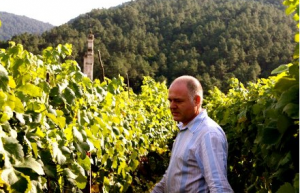
There is a quiet revolution of young winemakers in obscure corners of the earth, in impossible terrain, making palate enlightening wine in new ways with ancient and natural methods. Louis Rodriguez is one of them.
He is making wine naturally from indigenous grapes I’ve never heard of that taste everyday fresh, beautifully savory, exotically unfamiliar yet easy to drink.
My Spanish wine mentor, Chris Barnes calls Louis Rodriguez ‘Ribeiro Royalty’. I agree wholeheartedly. He is also the president of the DO Ribeiro and to many, the top producer in the area.
Louis works 27 (25 hectares in total) mostly prime south-facing plots. These plots are at high elevations on steep granite slopes over-looking the small bodega of Arnoia. This is a lush, and humid place with two rivers, the Mino and the Arnoia running through it.
He produces four wines, two red and two white. Less than 500 cases of each wine is made. The whites are blends of Treixadura, Albariño, Torrontés, Godello and Lado, while the reds are blended from Brancellao, Caiño, and Ferrol. All of the wines are fermented with natural yeasts and bottled unfiltered.
This wildly obscure place is impossibly hostile to agriculture. They harvest by hand because the land is too steep for machines. These terraces were originally cut by the Romans some 2000 years ago to supply wine for their armies marching to the Atlantic. Quite a place.
A Torna Dos Pasa Tinto is a blend of three indigenous grapes, Caiño Tinto, Ferrol, Brancellão. I was expecting something typically Spanish, like a great Mencia, I found something foreign, organic but incredibly well structured with layered tannins and a finish that lingered and evolved for a surprisingly long time.
This is a great bottle of wine. It inspired me to buy more and try it over time. It keeps delivering on its promise.
At $36 a bottle, it is a reasonable price for an exceptional wine.
Chambers Street Wines, always the champion of the small, the unknown, the impossible to find, the organic, the reasonable and the incredible has some in stock as of this post.